
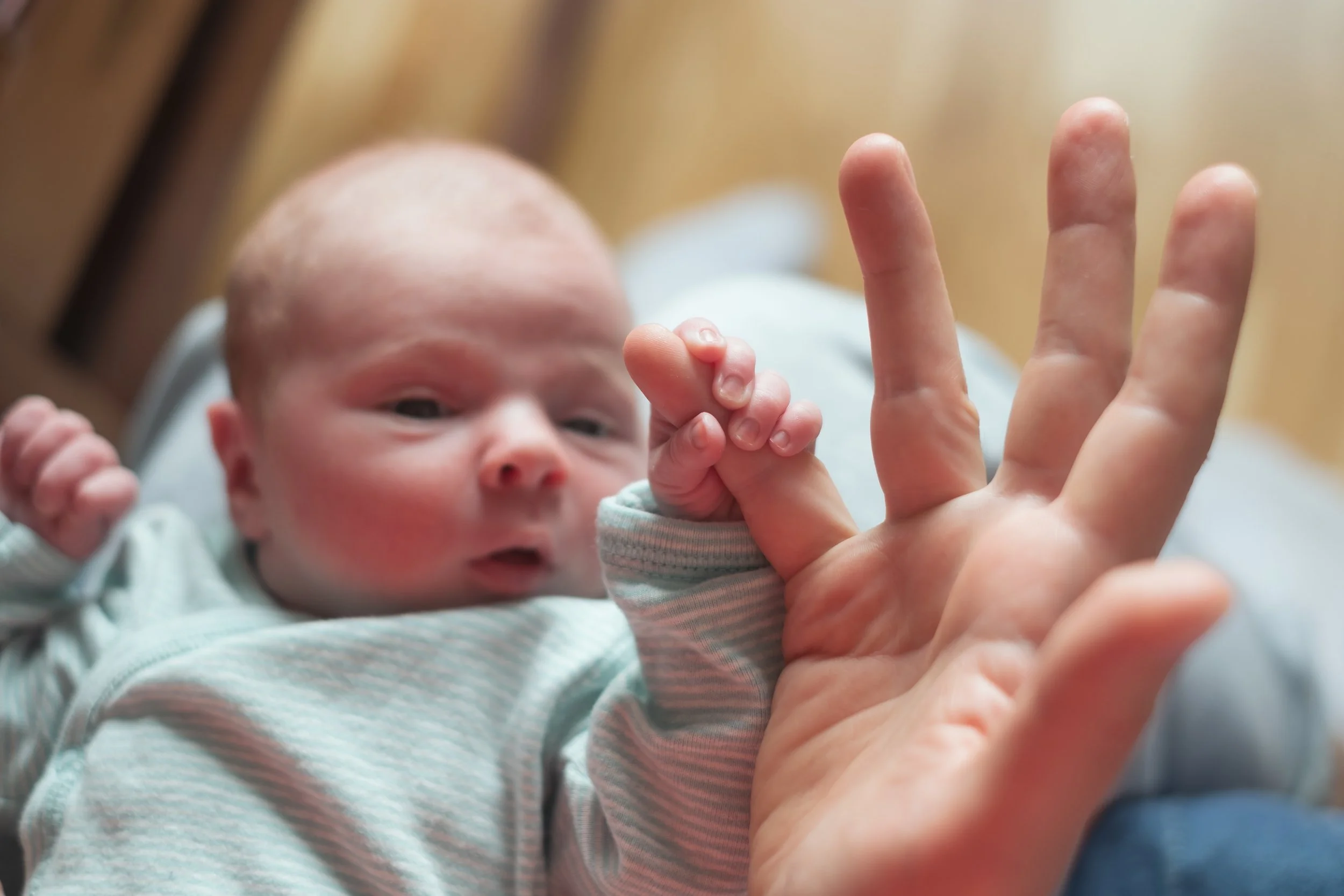

Have you ever placed your finger into Baby's tiny hand and felt their fingers curl tightly around it? It's one of those wonderful moments that parents remember. Baby's hand seems so small, yet their grip can be surprisingly strong!
But did you know that this adorable little grasp is actually a primitive reflex called the Palmar Grasp Reflex?
Primitive reflexes play an important role in Baby's early neurological development. Let's explore what this reflex is, why Baby does it, and how it gradually changes as they learn to use their hands.
What Is the Palmar Grasp Reflex?
That tiny hand wrapped around your finger is more than an adorable newborn moment. It's a glimpse into Baby's developing nervous system.
The Palmar Grasp Reflex is an automatic response that causes Baby's fingers to curl around something that touches or presses against the palm of their hand.
Baby isn't deliberately deciding to hold your finger. Their nervous system is responding automatically to the sensation of touch.
This reflex is one of the many automatic movements present in early infancy that provide important information about Baby's developing nervous system.
Why Does Baby Hold Your Finger So Tightly?
When Baby grasps your finger, you might be surprised by just how strong their grip can be!
When something touches their palm, sensory receptors in the skin send information through the nervous system. This activates an automatic response that causes the muscles in Baby's fingers to contract. The result is that wonderful little grasp.
Because the response is involuntary, Baby doesn't yet have full control over when they hold on or let go.
This is why a newborn may grip your finger tightly and hold on for quite a few seconds. At this stage of development, Baby cannot intentionally pick up a toy and release it.
Although the Palmar Grasp Reflex can be surprisingly strong, Baby should never be lifted or supported by their grip. They can release their fingers suddenly without warning.
Shifting from Reflexive Grasping to Purposeful Movement
During the first few months, Baby spends a great deal of time discovering their body. They begin looking at their hands, bringing them toward their mouth, and exploring how their fingers move.
At first, many hand movements are uncoordinated. Baby may accidentally touch a toy or close their fingers around something without intending to.
But with repeated opportunities to move, touch, and explore, their hand movements become increasingly purposeful.
Eventually, Baby begins reaching for something they want rather than simply grasping whatever touches their palm.
The Palmar Grasp Reflex gradually becomes less prominent as Baby's nervous system matures and voluntary control of the hands develops. This transition from automatic grasping to purposeful hand movements is an important part of early motor development (1).
And it all happens through the remarkable process of Baby's growing brain learning to coordinate sensation and movement.
When Does the Palmar Grasp Reflex Disappear?
The Palmar Grasp Reflex is normally present at birth and gradually becomes less noticeable as Baby's nervous system matures. For most babies, the reflex fades between 4 and 6 months of age.
But this doesn't mean Baby suddenly stop holding things! Instead, something exciting is happening.
Baby is beginning to develop more control over their hands.
You may notice that Baby starts to:
Open their hands more frequently.
Bring their hands together.
Reach toward interesting objects.
Grasp a toy intentionally.
Explore their hands and fingers.
Gradually learn to release objects.
These skills develop over time, and every Baby follows their own developmental journey. The important change is that Baby is moving from an automatic grasp toward a more purposeful one.
If Baby's hands remain tightly fisted, their grasp seems noticeably different between hands, or you have concerns about their development, speak with a qualified pediatric healthcare professional.
How Can Parents Encourage Healthy Hand Development?
The good news is that you don't need special equipment or complicated exercises to give Baby opportunities to explore their hands. Here are a few ideas that you can do at home to provide everyday touch, movement, and sensory play experiences:
1. Offer Your Finger to Hold
Gently place your finger against Baby's palm and allow their fingers to curl around it. Enjoy the moment and notice how Baby responds to your touch.
2. Give Baby Opportunities to Explore Their Hands
Allow Baby to bring their hands together, touch their face, and explore their fingers.
When Baby is awake and supervised, give them plenty of opportunities to move their arms and hands freely without being swaddled. For sleep, always follow safe-sleep recommendations, including stopping swaddling when Baby shows signs of attempting to roll.
3. Offer Gentle Hand Massage to Baby
Warm, gentle touch can introduce Baby to different sensations across their palms, fingers, and hands.
Take a little baby-safe massage oil and gently stroke from Baby's palm toward each finger. Follow Baby's cues and allow their hands to open naturally without forcing their fingers apart.
For more information, read our article on How to Choose the Best Oil for Baby Massage.
4. Encourage Reaching and Grasping
As Baby becomes interested in toys, offer lightweight, age-appropriate objects with different textures within easy reach.
Give them time to explore, touch, and eventually grasp objects independently.
5. Make Time for Floor Play
Supervised tummy time and other comfortable floor-play positions give Baby opportunities to move their arms, bear weight through their hands as they become ready, and explore their surroundings.
Remember, the goal isn't to make Baby reach a milestone sooner. It's to provide enjoyable opportunities for movement and discovery.
Learn More About Baby's Primitive Reflexes

The Palmar Grasp Reflex is just one of the primitive reflexes that help us understand Baby's early development. If you're curious about how these automatic movements work, explore our articles on Primitive Reflexes and What Is the Startle Reflex and Why Does It Matter?
At Best Beginnings, we help parents discover simple ways to support Baby's early development through our Five Pillars: Touch, Movement, Primitive Reflexes, Rhythm and Sound, and Sensory Play.
In the program, we explore eight important primitive reflexes, how they work, what stimulates them, and simple activities you can enjoy with Baby at home.
Learn more about the Best Beginnings Online Baby Massage and Movement Program at bestbeginnings.ca.
Reference
Futagi, Y., Toribe, Y., & Suzuki, Y. (2012). The grasp reflex and Moro reflex in infants: Hierarchy of primitive reflex responses. International Journal of Pediatrics, 2012, Article 191562.