
Why Your Voice Has Such a Powerful Effect on Baby


Many parents notice it almost right away. Baby may pause when you speak, relax when you hum, or settle more easily when you talk through a diaper change or bedtime routine. Even without understanding words, Baby clearly responds to the sound of your voice. It often feels like your voice reaches Baby before anything else does.
This response is not accidental. Baby’s nervous system development is wired to recognize and respond to familiar voices and gentle rhythm and sound from the very beginning (1). Long before language develops, sound plays an important role in helping Baby feel safe, organized, and connected to the people caring for them (2).
Baby Recognizes Your Voice Before Understanding Words
Baby does not need to understand what you are saying to benefit from hearing your voice. From pregnancy onward, Baby becomes familiar with the sound, tone, and rhythm of voices heard often (3). After birth, these familiar sounds can feel grounding in a world that is otherwise full of new sights, sensations, and experiences.
When you speak, hum, or gently talk through what you are doing, Baby’s nervous system recognizes something known and predictable. This familiarity supports a sense of safety and helps Baby move more easily through transitions, new routines, and everyday care moments (2).
Rhythm Helps Baby’s Nervous System Organize Itself
Beyond words, rhythm is a powerful support for Baby’s early regulation. The natural rise and fall of your voice, a steady pace, and repeated patterns help Baby’s body and brain make sense of what is happening around them (4).
Gentle rhythm can support calming during moments of fussiness, improve tolerance for handling and movement, strengthen parent-Baby connection during care routines, and make it easier for Baby to relax and fall asleep. This is one reason Baby may respond so strongly to a calm, steady voice, even when nothing else seems to be working.
Your Voice Supports Regulation, Not Performance
Many parents worry they are not good singers or do not know what to say. The good news is that Baby does not need performance. Baby needs you, just as you are.
Talking through diaper changes, humming while rocking, softly narrating bath time, or using a calm, rhythmic tone during feeding all provide meaningful sensory input. These moments help Baby feel supported, connected, and more at ease in their body and environment.
Everyday Moments Are Where Voice and Rhythm Matter Most
Your voice shows up in small, ordinary moments throughout the day, often without you even realizing it. It might be during a diaper change when you talk Baby through what you are doing, while getting dressed in the morning, or as you gently rock and sway before sleep. Feeding time, cuddles on the couch, and those quiet minutes before naps are all moments where your voice naturally becomes part of Baby’s experience.
When your voice slows down, softens, or follows the rhythm of what Baby is feeling, it helps their nervous system feel more secure. These simple, familiar patterns of sound make it easier for Baby to settle, relax, and move comfortably from one part of the day to the next.
How Voice and Rhythm Fit into the Best Beginnings Approach
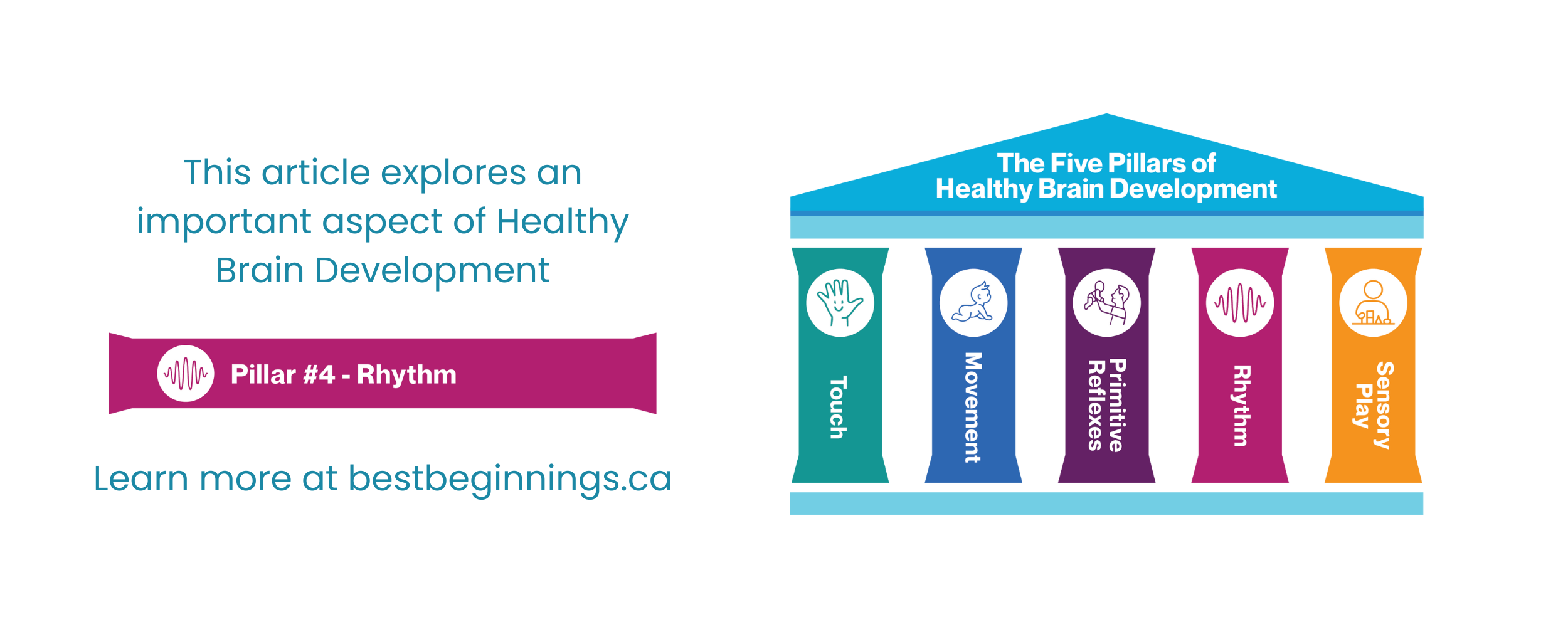
At Best Beginnings, rhythm and sound are one of the Five Pillars of Healthy Brain Development. Alongside touch, movement, primitive reflexes, and sensory play, voice and rhythm support bonding, co-regulation, and Baby’s ability to learn calm from the people around them (4).
In the Best Beginnings Infant Massage and Movement Program, parents learn how to naturally combine gentle touch, movement, and calming voice cues during everyday routines. These small, intentional moments help parents feel more confident while supporting Baby’s comfort and ongoing nervous system development.
👉Learn more about the Best Beginnings Infant Massage Program and how it supports connection, calming, and early development.
References
(1) DeCasper, A. J., & Fifer, W. P. (1980). Of human bonding: Newborns prefer their mothers’ voices. Science, 208(4448), 1174–1176.
(2) Brazelton, T. B., & Nugent, J. K. (2011). The Neonatal Behavioral Assessment Scale (4th ed.). Cambridge University Press.
(3) Moon, C., Cooper, R. P., & Fifer, W. P. (1993). Two-day-olds prefer their native language. Infant Behavior and Development, 16(4), 495–500.
(4) Montirosso, R., & McGlone, F. (2020). The body comes first: Embodied reparation and the co-regulation of infant affect. Neuroscience & Biobehavioral Reviews, 113, 77–87.